Monthly Archives: March 2026

Executive Officer – Case Study

National Not-for-Profit organisation  – Executive Officer Case Study 

Our client, a highly respected Not-for-Profit organisation, partnered exclusively with Osborne Executive Search to assist in the recruitment of an Executive Officer. This senior leadership role was a key appointment, marking the beginning of a new chapter in the organisation’s development. The appointed individual would take full responsibility for the organisation’s performance and future strategic direction. A crucial aspect of the role was ensuring the organisation maintained the highest standards of governance and compliance, in line with its parent company. 

Our Process 

As this was a newly created position, it was essential for us to meet with the client to gain a deep understanding of the role. We needed to fully grasp the purpose of the position, the organisation’s long-term expectations, and its workplace culture. 

We held multiple virtual meetings with the organisation but also recognised the importance of visiting them onsite. This allowed us to better understand the community in which the organisation operates. 

We developed a comprehensive marketing and recruitment strategy, commencing  with the creation of a detailed candidate booklet and a microsite. The microsite featured accessible candidate information, including a sign language video. Using our full range of recruitment tools—including our extensive candidate database, professional networks, LinkedIn Recruiter, major job boards, and industry-specific sites—we attracted an exceptional calibre of candidates, both nationally and internationally. 

Our screening process was thorough. We conducted initial meetings with candidates in person and via MS Teams.  A selected longlist of candidates was presented to our client for shortlisting. Each candidate was accompanied by a CV and a detailed cover letter, providing insight into their key strengths and what they could bring to the role. After a review meeting, the recruitment selection board shortlisted candidates for first-round interview. 

A dedicated interview panel was appointed, and we supported the process by providing a range of competency-based interview questions and a structured interview marking sheet for the Panel to use. Following the first round of interviews, the panel carefully deliberated and selected the top scoring candidates to progress to the second round.  

As part of the final round selection process , the candidates were asked to deliver a presentation outlining their strategic vision for the organisation. 

The Result 

After a highly competitive second-round process, a candidate was selected. An offer was made and accepted. Both the client and the successful candidate were extremely pleased with the outcome. 

The entire recruitment process was completed within 12 weeks. 
CEO – Case Study

Case Study: Recruitment for CEO of a significant Irish Charity  

The Assignment 

Osborne Executive Search partnered with a prominent Irish charity, dedicated to supporting victims of sexual abuse and violence, to appoint a visionary CEO to drive its mission forward. Following the departure of a long-serving CEO, the charity faced challenges including leadership transition, evolving service demands, policy shifts, and managing issues related to child abuse and online violence. Key to the role was developing strong, diversified funding strategies, with the charity’s operations primarily supported by the Department of Justice, HSE, grants, and fundraising coupled with demonstrated experience in non-profit leadership, financial acumen and an understanding of Ireland’s unique social sector landscape 

Our Process 

To ensure a successful and smooth recruitment process, an in-depth meeting was held with the client to understand the role, vision, mission, and the specific skills and attributes required to identify the ideal CEO. We crafted a detailed profile and competency matrix based on this information, guiding our search and selection criteria focusing on candidates with: 

  • Leadership experience in the not-for-profit or charity sector 
  • Strategic and operational expertise with a strong focus on mission-driven organizations 
  • A network within the Irish community, including government and media relations 
  • High emotional intelligence and resilience to navigate challenges and inspire staff 

 Our comprehensive sourcing strategy included a mix of proactive searches including   

  • Reaching out to Osborne Executives extensive database CV libraries, LinkedIn, and social media platforms engaging with a matrix of senior executives, industry bodies, and charity sector groups. 
  • Leveraged our professional networks, seeking referrals and recommendations for suitable candidates, targeting candidates with relevant experience in Irish non-profits, particularly in health, social care, and education sectors  
  • Placing strategic advertisements in Irish not-for-profit, charity, and executive recruitment publications to attract wider interest. 
  • Advertising over major Irish and international job boards and social media  

The recruitment process focused on assessing candidates’ alignment with the charity’s mission and their capacity to achieve sustainable impact. Key steps included: 

  • Candidates were screened by Osborne Executive based on their experience and track record in strategic leadership, sectoral and resource management in addition to evaluation of their decision-making approach, values alignment, and ability to inspire teams. 
  • A longlist of suitable candidates was presented to the appointed panel for shortlisting with successful candidates invited to first round competency-based interviews.  
  • Three candidates were selected for final round interview and were asked to present a strategy proposal for the charity’s future, enabling the Panel to assess strategic vision, innovative thinking, and practical application. 

 The Result
After a rigorous evaluation process, the panel selected a candidate with significant experience in the Irish non-profit sector, including several years in executive leadership roles. The successful candidate demonstrated adaptability and a strategic approach that was essential to navigate future challenges and foster growth in addition to being aligned deeply with the charity’s values ensuring that strategic decisions always reflected the organisation’s mission. The client and the new CEO were both extremely satisfied with the outcome. The entire recruitment process was completed within a 10-week period, from the initial client meeting to the acceptance of the offer.  

This case study exemplifies our commitment to understanding client needs, executing targeted recruitment strategies, and delivering successful outcomes even in the most challenging circumstances.

What 500 HR Leaders Told Us About Preparing for the EU Pay Transparency Directive

The EU Pay Transparency Directive is quickly moving from policy discussion to operational reality.

But how prepared are organisations really?

During a recent webinar on the directive, we asked more than 500 HR professionals and business leaders to share where their organisations currently stand.

The results were revealing.

Most organisations are not fully prepared yet.

While awareness of the directive is clearly high, very few organisations believe they are fully ready.

Our poll showed:

  • 51% are actively preparing
  • 41% are aware but have not yet begun preparing
  • Only 3% say they are fully prepared

In other words, most organisations recognise the importance of the directive – but many are still in the early stages of readiness.

Salary transparency still isn’t the norm

One of the key requirements under the directive is salary transparency during recruitment.

Yet our results suggest many organisations will need to change their current practices.

When asked whether salary ranges are included in job advertisements:

  • 46% said no
  • 35% said sometimes
  • 19% said yes

This means nearly half of employers are not currently publishing salary ranges at all.

Pay structures may be the biggest gap

Perhaps the most telling insight from the poll was around internal pay frameworks.

Only 26% of respondents said their organisation has a clearly defined pay structure across the business.

Meanwhile:

  • 43% said pay structures exist only in some areas
  • 30% said they have no defined pay banding system

Without clear pay frameworks, demonstrating pay equity and responding to employee questions about pay transparency could become significantly more challenging.

Encouraging progress on pay gap analysis

There are some positive signs.

A majority of organisations are already reviewing pay equity data, with 65% saying they conducted a gender pay gap analysis within the past year.

However, 17% of organisations have never carried out such an analysis, highlighting that some employers are still at an earlier stage of pay transparency readiness.

What concerns organisations most?

When asked about the biggest challenges ahead, respondents pointed to structural change rather than compliance alone.

The top concern was job evaluation and pay structures (61%), followed by:

  • Internal employee communication (42%)
  • Legal and compliance risk (42%)
  • Pay gap reporting requirements (36%)
  • Data and HR systems capability (27%)

In short, the directive isn’t just about reporting – it’s about how organisations design, manage and communicate pay.

The real work starts now

The poll results highlight an important reality: awareness of the EU Pay Transparency Directive is strong, but readiness varies significantly.

For many organisations, the coming months will involve reviewing pay frameworks, improving data visibility and building more transparent approaches to pay.

And as the directive moves closer to implementation, the organisations that start preparing now will likely find themselves in a much stronger position.

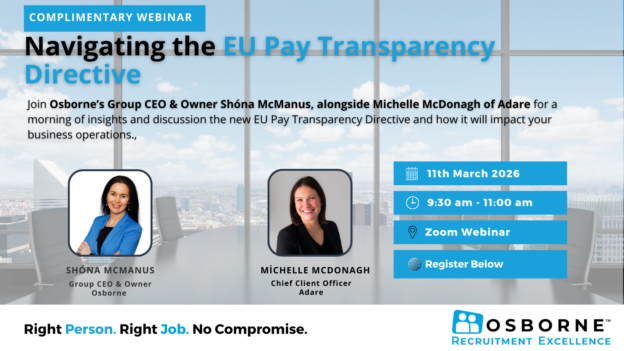
Osborne Talent Series Webinar: Navigating the EU Pay Transparency Directive

Osborne Talent Series Webinar:

Navigating the EU Pay Transparency Directive 

Complimentary Webinar

Date:                    Wednesday 11th March
Time:                    09:30am – 11:00am
Location:            Zoom Webinar – https://us02web.zoom.us/webinar/register/WN_t_SCezj4S1qS_yG2xxE-Dw
Hosted By:         Shóna McManus, Group CEO & Owner Osborne
Presented by:   Michelle McDonagh, Chief Client Officer, Adare

We are delighted to invite you to our first Osborne Talent Series Webinar of 2026 in association with our strategic HR partner Adare.

This webinar is COMPLIMENTARY but registration is essential. Please register here

Join our upcoming webinar on the EU Pay Transparency Directive – with the 7th of June deadline fast approaching, Organisations need to act now. Michelle McDonagh of Adare will break down what the new rules mean in practice, highlight the key risks of being unprepared, and share clear, practical steps to help you get ready for compliance.

Who should attend?

Business Leaders, Senior Managers, Business Owners, HR Professionals and those tasked with the responsibility for managing change within their organisation.


Hosted By:

Shóna McManus, Group CEO & Owner of Osborne

Qualified to MBA, Shóna McManus is a highly accomplished, respected and recognised global recruitment business leader. Since taking the reins of Osborne in April 2013, Shóna’s innovative, authentic and purposeful leadership has resulted in the growth and transformation of Osborne into the multi-award-winning international recruitment firm we know today.​

Under her guidance, Osborne has increased its footprint, turnover, profits and headcount tenfold over the past ten years, adding numerous awards to its repertoire including ERF Best Large Agency of the Year 2023, whilst leading the organisation to successfully help thousands of job seekers and employers in the recruitment process to ‘find the right person, for the right job, no compromise’.​

Shóna has recently qualified with a Diploma in Company Direction from the Institute of Directors, is currently Co-Chair of The Mill Enterprise Centre Board and is a Director on Drogheda Port Company Board. She was previously Vice-President of the ERF, President of Drogheda & District Chamber and is also involved in Regional, National and Government committees and strategic work groups and projects.​ Shóna has also recently took part in and completed Enterprise Ireland’s Leadership for Growth programme alongside 36 other CEOs, this programme aims to empower business leaders with the visionary, strategic, and innovative skills needed to scale Irish companies on the global stage.

Shóna has also been recognised on the SIA Global Power 150 Women in Staffing list for eight consecutive years and has been named in the SIA Staffing 100 Europe list for the past 5 years


Presented By:

Michelle Mc Donagh, Chief Client Officer MSc. HR Strategies, Chartered MCIPD, PGDip Employment Law

Michelle is an experienced Human Resources and Employment Law practitioner. Advising and supporting a wide variety of organisations across the private, not for profit and public sector Michelle uses her expertise and strategic focus to analyse organisations and build a tailored HR model to support achievement of the organisational goals. Key areas of focus are organisational design, enhancing critical skills, leadership development and day to day practical Human Resources and Employment Law advice underpinned by a positive employee experience.

Don’t miss out  –  Register Here today*

Feel free to share this invite with colleagues or peers who would have an interest in the topics being covered.
*Upon registration, participant details will be issued to both Osborne and Adare.